Showing posts with label clothing. Show all posts

Monday, September 12, 2011

Chenille = Caterpillar


Did you know that the word "chenille," which is the name of a type of fabric characterized by a thick, tufted cording, often woven into patterns above a plain ground, comes from a French word for "caterpillar?" It is another one of those French words that comes in to English and we learn it as kids without knowing what it originally meant.

Chenille yarn is created by twisting shorter threads of yarn called pile threads between two core threads of yarn. The shorter pile threads then poke out at right angles. It is these pile threads poking out that gives the yarn a fuzzy, tufted appearance that feels like velv
et. The word chenille originally referred to the cording alone, which resembled a fuzzy caterpillar. Starting inthe 18th century, it was used for embroidery, fringe, and tassels on both furniture and clothing, and eventually evolved into a fabric. Sometimes the fabric has tufted sections that are woven into patterns, and sometimes the chenille tufts have no plain ground, and seem like a very soft, velvet like fabric that is softer, which generally a longer pile.

Chenille fabric c
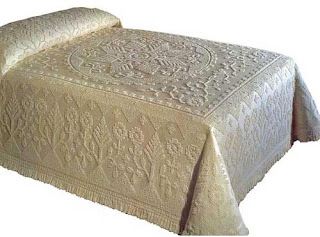
omes in and out of fashion. Growing up in the early 1950s, there had been a big vogue for chenille in the late 1930s and 40s for bedspreads, pillows and bathrobes, so for me, in one of my Proustian moments, I can remember being put to sleep (to nap) on one of these bedspreads at my aunt's house or grandmother's, and I remember lying there before falling asleep, picking at the small tufts of corded material, and tracing the patterns with my fingers. Later, in my teens, when I needed a new bedspread, I asked for a chenille one, but made in a heavier cotton with a pattern that was stiffer and less comfortable, I could fall asleep on the top of my bed on a lazy weekend afternoon and wake up with a pattern of red indentations on my face and arms where I lay against the fabric.

In the last couple of decades the fabric has evolved tremendously. The fabric has developed into a much softer version. What had been usually used for bedspreads and bathrobes, became adopted for jackets and vests. These outfits at first looked like they had been artfully made from an old bedspread or curtain, but in fact the fabric patterns had been woven for the garment. Still later, in the 1970s, when it really was developed to be made into garments, chenille fabic that was made completed from the tufted yarn added a new fabric with a unique feel and drape. The last decade saw the use of chenille in a variety of boas neckwarmers. Usually woven in cotton these days, it can also be made from silk, rayon, or even wool.

There is currently an organization dedicated to the improvement and development of chenille manufacturing processes. This organization is known as the CIMA, or Chenille International Manufacturers Association. Visit them for more detailed information.

Thursday, October 4, 2007

About Sumptuary Laws


Throughout the history of mankind, clothing has been not only a source of personal adornment and protection, but (unlike most clothing today) an announcement of one's status in society. Often those in power have tried to dictate what people in lower classes might wear. Such laws regarding dress are called sumptuary laws, and were quite common in Medieval and Renaissance Europe. Often nobles were offended when some members of the merchant class, wealthier than their noble "betters," wore fabrics and materials that were more expensive than those worn by the upper classes, and laws were instituted to prevent them from wearing such things.

The wearing of fur was regulated in Tudor England, with only royalty allowed to wear certain furs, and others that could only be worn by privileged people (for example, only those above the rank of a viscount could wear sable and to be able to wear martin (or even velvet) one had to be worth over two hundred marks a year).

In Elizabethan times, the color crimson was only allowed to be worn by royalty (except in underclothing), and the middle-classes were restricted to using velvet only on sleeves.

Sometimes the laws were created to prevent a drain on the economy by the outgoing of gold to foreign countries. In the early 17th century, France outlawed extravagant laces and embroideries on clothing to prevent nobles from sending too much money to the Venetian manufacturers of such products. In fact, Louis XIV finally brought Venetian lacemakers to France and set them up in cities throughout the country, then encouraged the wearing of lace (gold and silver trimmings were still reserved for the exclusive use of the King and his court, however).

Modesty, too, was challenged by fashion, and laws were created to fight trends. In the 14th and 15th centuries, men's tunics and jackets became so short in fashionable circles that it outraged the clergy, who had laws instituted to prevent the hemlines from growing any shorter (but, even so, the hemline eventually reached the waist, and the length of hose subsequently rose from thigh-height to the waist).

More often than not, the laws were hard to enforce and were often violated, as the growing wealth of the merchant classes competed with the nobles.

For further reading, check out these sites:

http://en.wikipedia.org/wiki/Sumptuary_law

http://www.elizabethan-era.org.uk/elizabethan-sumptuary-laws.htm

Wednesday, September 26, 2007

About Crinolines


In the late 1850s and into the 1860s the fashion for very wide skirts led to the invention of the crinoline, which was a hooped cage contraption that allowed skirts to be made very full without the extra weight of many petticoats. At their extreme extent the hems of skirts measured as much as ten yards, according to a contemporary. Most men found this female fashion ridiculous, and many joked about its absurdity, at least until they got used to it.

    The crinoline caused quite a few unexpected problems. Where only a few years before a hostess could seat two or three women on a parlor sofa, now there would be barely enough room for the skirts of one. And many a careless woman would find her skirt sweeping Victorian bric-a-brac residing on a table onto the floor. Many a fellow passenger on an omnibus, too, scowled when a full-skirted women tried to board and shove herself into a single available seat, drowning her fellow passengers in folds of material from her dress.

    There were more dangerous problems, too. The dresses could catch strong winds, and literally lift and blow their wearers off their feet, which was extremely dangerous when strolling near cliffs or high walls. Sometimes the hooped petticoats of pedestrians would get entangled in the wheels of passing coaches or carriages, causing messy or injurious accidents. Women who fell into water were often dragged down by the weight of the yardage in their skirts, drowning before they could be rescued.

    Fire, too, was a big hazard, especially in an age of oil lamps, candles, and wood stoves. Many skirts were made of highly flammable materials and would swiftly catch fire should a skirt get caught too near an open flame while the wearer tried to lean in to cook or stoke a fire in the fireplace. A terrible disaster occurred on December 8, 1863, when 2000 women were burnt to death in a cathedral in Santiago, Chile, because the vast quantities of materials in their skirts added to feed the flames.

    "Take what precautions we may against fire, so long as the hoop is worn, life is never safe. All are living under a sentence of death which may occur unexpectedly in the most appalling form," wrote a commentator in London's The Illustrated News of the World in 1863.

Tuesday, September 25, 2007

The History of Chef's Hats

Chef Hat
The chef's hat or toque is a distinctive article of clothing which immediately identifies the wearer, whether amateur or professional, as a preparer of foods. Like many articles of clothing, it has a long history, riddled with fables.


One story has it that the hat originated in ancient Assyria, when the king's chefs were so renowned that they were entitled to wear a crown of notoriety of their own, albeit in cloth, not precious metal. Another, more popular story says that in the 6th century, famous and learned chefs, fleeing Greece from the invading Turks, would hide out in Orthodox monasteries, where the monks wore tall black hats. The chefs copied that style, but in white, when they regained their freedom.


Chef Hat

The reality is much more mundane. In medieval and Renaissance times, chefs wore hats in the smoky, dirty kitchens for two reasons: to keep their hair (and lice?) from falling into their eyes or the food that they were preparing, and to prevent the grease, gunk and soot on the ceiling from falling down in their heads. The shapes of hats varied in size and color at that time- some chefs wore berets, others skullcaps or stocking caps, while still others wore a version of the mortarboard style that we associate with graduation today.


At some point, some chef realized that making the crown of these brimless (that is what toque means, a brimless hat) caps taller helped to move trapped heat (kitchens were notoriously hot, at all times of the year) away from the head and up into the hat, so hats gradually got taller. As kitchens grew larger in the 18th century, it became more important to know at a glance who gave the orders that really counted. That's what the tall toque did- by giving the Head Chef the tallest hat, he could be found easily. A Viennese chef named Antonin Careme set the ultimate standard by propping his cap up with a piece of cardboard, and chefs have followed suit for centuries, though the cardboard has since been replaced by starch.


And, of course, as hygiene improved and people became more concerned with germs, white became the standard color (as in hospitals) for cleanliness, professionalism, and efficiency.


Chef Hat


Another probably apocryphal story concerns the pleating in the tall hats. In "A Pageant of Hats, Ancient and Modern," by Ruch Edwards Kilgour (copyright, 1958) wrote: "It was regarded as natural that any chef, worthy of the name, could cook an egg at least one hundred ways. The most-renowned chefs often boasted that they could serve their royal masters a different egg dish every day in the year, some of them so cleverly prepared, that aside from being highly palatable they had flavors as widely different as completely diverse kinds of foods. Today, noted chefs are seldom called upon to prove their prowess in this manner. Nevertheless, they still wear one hundred pleats on their hat, the old-time symbol of their skill in the egg department." Most toques these days sport many fewer than 100 pleats, and the pleats, in reality, are mainly there to help support the fabric in staying up.


Today, chefs are less concerned about their headgear. Kitchens are often air-conditioned, and hats are sometimes not worn at all. Some chefs wear baseball caps. Some chef's hats are now made out of paper and are disposed of at the end of the day. In some grand kitchens or restaurants, the style and shape of the hat denotes what kind of chef you are, whether you make the sauce or soup or specialize in desserts, but there are no set rules.


The next time you see a chef, notice what kind of hat he's wearing. Is it a tall, cylindrical one made out of paper, or a cloth one that resembles a loaf of un-baked bread? Then remember that such a simple article of clothing has such a long and fabulous history!


SOURCES: The LA Times, March 21, 2001, and from various spots on the web, including the Ed Kane at the Las Vegas Register (http://lvrj.com/lvrj_home/1998/Mar-18-Wed-1998/lifestyles/7128827.html), and the folks at The Straight Dope (http://www.straightdope.com/classics/a3_025.html)